

As an Amazon Associate, we earn from qualifying purchases.
In this post, we explain the different types of graphic design for print. We also give examples of how certain materials have adapted to new trends, reducing the need for traditional printing. For example, modern businesses now prefer creating PDF eBooks instead of fully printed books.
- Types of Graphic Design
- Stationery Design: What It Is and How It Has Evolved
- Newspaper, Book, and Magazine Design
- Packaging and Label Design: Purpose and Modern Adaptations
- Apparel Graphic Design: Wearable Branding in a Digital Age
- Signage Design: High-Impact Visual Communication
- Greeting Cards and Announcements
- Promotional Product Design: Everyday Items as Brand Tools
- Poster Design: Visual Storytelling with Maximum Impact
- Brochure Design: Informative and Structured Print Communication
- Other Types of Graphic Design Include
- Frequently Asked Questions
- What are the main types of graphic design?
- Which types of graphic design pays the most?
- Which ools do professionals use to create print designs?
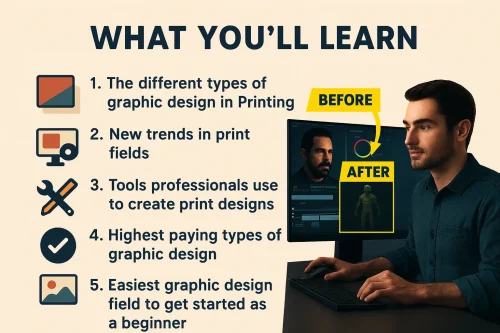
Printing is not as profitable as it used to be. However, ruling it out as dead has often proven to be wrong. Although some types of print are changing to reduce the need for physical output, print design still plays an important role in business communication.
We explore where different types of print graphic design are still widely used today and how they continue to evolve. Many businesses now choose digital publications and downloadable content, allowing them to save costs while reaching a wider audience.
Understanding both the lasting value of print and its evolution into digital presentations and platforms helps designers stay relevant in a changing creative landscape. If you want to see different print designs I have created, Click here.
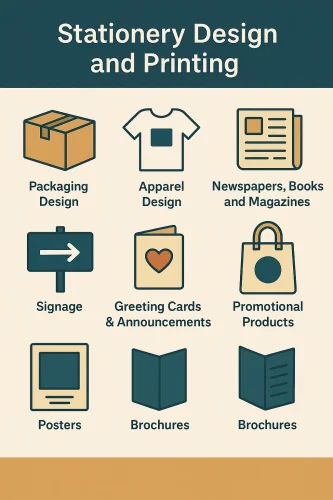
Types of Graphic Design
- Stationary Design and Printing
- Packaging Design
- Apparel Design
- Newspapers, Books and Magazines
- Signage
- Greeting Cards & Announcements
- Promotional Products
- Posters
- Brochures

Stationery Design: What It Is and How It Has Evolved
Stationery design is one of the oldest areas of graphic design for print. Stationery refers to official branded communication materials used within a business.
It includes items such as business cards, letterheads, envelopes, notepads, and complimentary slips. These elements help communicate information while representing a brand consistently and professionally.
In the past, businesses printed large volumes of envelopes. Today, with the rise of email, envelopes are far less common. To maintain a similar branding effect, many businesses now use email signatures that serve the same purpose as a branded envelope.
Letterheads are still used for official communication, while business or visiting cards help share contact information with potential clients. However, print volumes have greatly reduced. Some businesses now use eCards instead of traditional business cards, while others create electronic letterheads that can be emailed or printed on demand without large bulk orders.
Newspaper, Book, and Magazine Design
Books and magazines are still printed for sale and information sharing. However, many publishers now create digital versions that people can read on phones, tablets, and other devices.
Graphic designers are still hired to design layouts, but fewer physical copies are printed. The remaining versions are often shared as electronic downloads, making content more accessible and cost-effective.
Packaging and Label Design: Purpose and Modern Adaptations
Packaging and label design is one of the most impactful areas of graphic design for print. It focuses on how products are presented, protected, and communicated to customers through physical packaging such as boxes, labels, wrappers, and shopping bags.
Packaging is often the first interaction a customer has with a product, making it a critical factor in purchasing decisions. Before reading a description or trying a product, customers often judge it by how it looks on the shelf.
Effective packaging design tells a story in just a few seconds. It communicates brand personality, product quality, and value through color, typography, imagery, and layout. A well-designed label can make a product stand out in a crowded market, while poor design can cause it to be overlooked.
Over time, packaging design has adapted to new trends and technologies. While physical packaging remains essential, many brands now create digital mockups, 3D renders, and online product previews for e-commerce platforms. Labels are also designed with digital visibility in mind, ensuring they look just as appealing on screens as they do in real life.
Apparel Graphic Design: Wearable Branding in a Digital Age
Apparel graphic design focuses on creating visuals for clothing and wearable products such as t-shirts, hoodies, hats, jackets, towels, and accessories. Because everyone wears clothes, apparel design has a massive reach and consistent demand.
This type of design appears across many industries, including fashion brands, corporate merchandise, sports teams, events, and promotional campaigns. Apparel turns design into a moving advertisement—wherever the wearer goes, the message travels with them.
The evolution of apparel design is closely tied to digital tools and production methods. Print-on-demand services have reduced the need for bulk printing, allowing designers and brands to produce clothing only when orders are placed. This shift makes apparel design one of the most flexible and profitable print-related niches.
Signage Design: High-Impact Visual Communication
Signage design is one of the most visible forms of graphic design for print. It includes storefront signs, banners, billboards, vehicle wraps, trade show displays, and directional signage.
Signage relies on clear messaging, strong typography, and bold visuals. Since signs are often viewed from a distance or at high speed, readability and visual impact are critical. Vector-based artwork is commonly used to ensure designs scale cleanly across different sizes.
While signage remains deeply rooted in print, it has evolved with technology. Many signs now include QR codes, LED displays, and interactive elements that connect physical spaces to digital experiences.
Greeting Cards and Announcements
Greeting cards and announcements are designed for personal and emotional moments such as weddings, birthdays, holidays, graduations, and other life milestones. These designs are often sentimental and meant to be kept as memories.
Although traditionally printed and mailed, many people now use digital alternatives such as eCards and online invitations. These options are faster, more affordable, and environmentally friendly while still feeling personal and branded.
This niche also allows designers to sell directly to consumers through online shops and digital marketplaces, offering both printed and digital products.
Promotional Product Design: Everyday Items as Brand Tools
Promotional product design involves creating graphics for branded merchandise such as pens, mugs, lanyards, wristbands, notebooks, tote bags, and tech accessories.
The goal is simplicity and clarity. Designs must adapt to different shapes and materials while remaining readable and visually effective. With modern manufacturing methods, promotional items are now produced in smaller quantities, often on demand, reducing waste and costs.
Poster Design: Visual Storytelling with Maximum Impact
Poster design is one of the most expressive forms of print graphic design. Posters are commonly used for concerts, films, festivals, exhibitions, and promotions.
A successful poster must grab attention instantly while communicating essential information. Designers often create posters that work both in print and as digital assets, extending their reach through social media and online platforms.
Brochure Design: Informative and Structured Print Communication
Brochure design focuses on presenting information clearly and attractively. Brochures include tri-folds, flyers, menus, booklets, and presentation folders.
Unlike posters, brochures are designed to be read closely. Many businesses now create digital brochures that can be emailed or downloaded, while still printing copies when necessary.
Other Types of Graphic Design Include
- UI/UX design
- Motion graphics
- Brand identity design
- Packaging design
- Web Design
Frequently Asked Questions
What are the main types of graphic design?
The main types of graphic design include branding and identity design, advertisin , promotion and marketing design, web and UI design, publication design, packaging design, motion graphics design, environmental design, and illustration.
Which types of graphic design pays the most?
The best paying graphic design sub niiche is, UI/UX design, motion graphics, brand identity design, and packaging design. This is due to their complexity and impact.
Which ools do professionals use to create print designs?
The tool you choose depends on the task at hand. Illustrator, Photoshop and InDesign by Adobe offer a full printing design suite. If you are designing books, magazines or booklets, most pros use InDesign. For simple one-page designs like business cards and stationery, most designers use Illustrator.